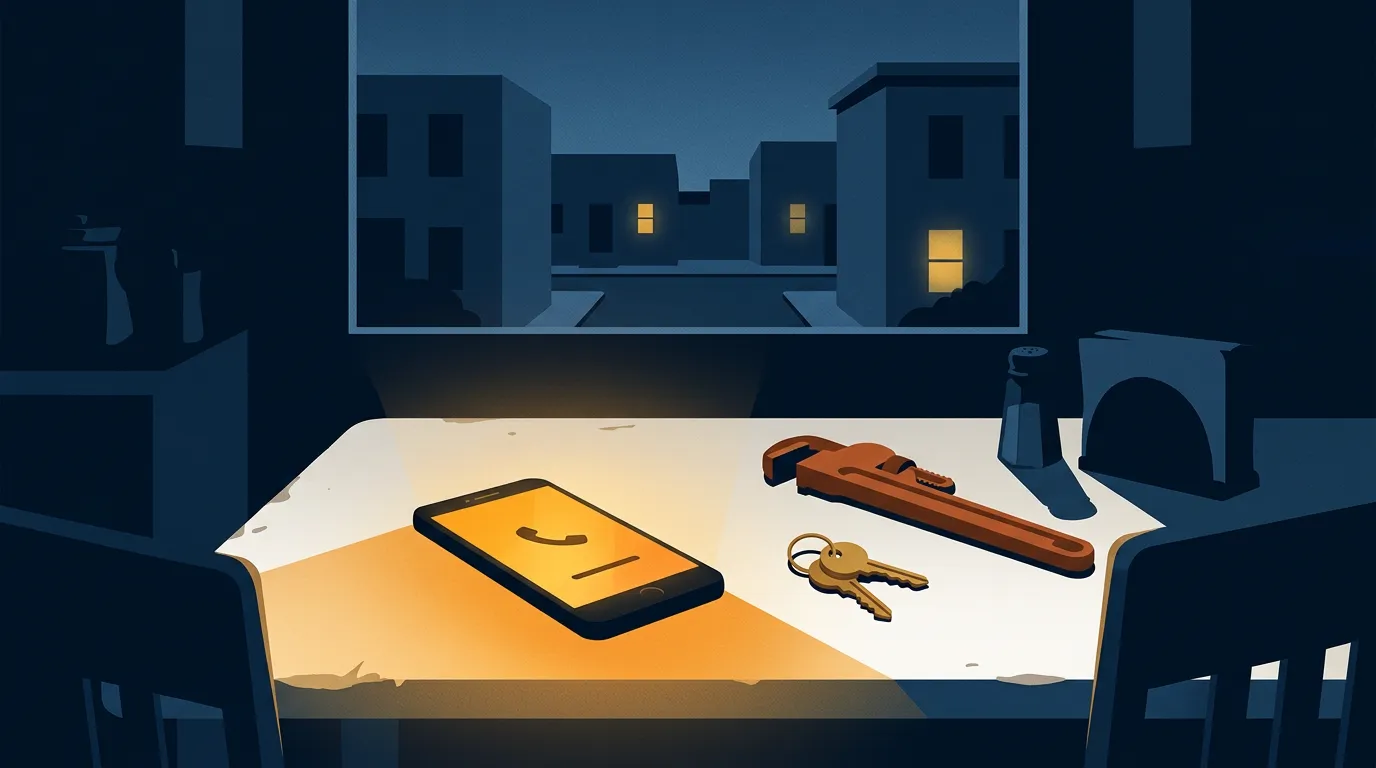
You're under a Bethesda kitchen sink at 4:45pm on a Friday, the P-trap is corroded shut, and your phone has buzzed four times since you got under there. You are not answering it. Nobody sweating a fitting in Falls Church or Rockville or Alexandria answers it either. The question isn't whether you're going to miss calls — you are, every single week — it's what happens to those calls after you miss them.
That's the actual decision. Not "should I get an answering service," but "which of these five things happens to my phone when I can't get to it," because right now something is already happening, you just haven't priced it out. So let me walk through all five, including the one I sell, with real numbers instead of vague pitches.
Option 1: voicemail (free, and it costs you twice)
This is what almost every one-truck DMV shop runs today, because it's already on the phone and nobody had to set it up. The problem isn't that it's free — free is good — it's that voicemail doesn't actually do anything. It's a recorder, not a receptionist.
Here's the part that doesn't get said enough: even the good outcome — the caller actually leaves a message instead of hanging up — is still work. You have to listen to it, figure out if it's a real job or a wrong number, call back, probably miss them because they're at work too, play phone tag for a day, and eventually book it. That's forty-five minutes of admin spread across your evening, after a day that already started at 6:30am loading the van in Manassas traffic. Voicemail didn't answer the call. It rescheduled the work onto your night.
And a lot of callers never leave that message at all. Someone with a slab leak spreading under their Potomac hardwoods doesn't wait for a callback — they're already dialing the next number on the search results page. Voicemail's real cost isn't the $0 on the invoice. It's the jobs that quietly went to whoever picked up, plus the homework you're doing at 9pm for the ones that didn't.
Option 2: a human answering service
Companies like AnswerForce or Smith.ai will answer live, 24/7, on plans priced by call volume. This is a real upgrade over voicemail — an actual human takes the name, the address, maybe the issue.
The catch is the pricing structure, not the concept. Most of these plans meter you — a set number of minutes or calls included, then a per-minute or per-call overage once you're past it. That sounds fine until you look at when you go over. It's not a random Tuesday. It's the week of a hard freeze when every service line in Prince George's County is bursting at once, or the first 95-degree stretch in July when every AC-adjacent plumbing call in Loudoun spikes. The exact week you need the phone covered most is the week your bill jumps. You're also usually talking to someone in a call center who has never sweated a copper joint, reading from a script, who can capture "customer says water is leaking" but can't tell a slow drip from an emergency that needs your on-call rate.
Option 3: part-time office help
Hiring someone — even 15-20 hours a week — to answer calls and manage the calendar. Real cost isn't just the hourly wage; it's payroll tax, onboarding time, and the fact that a part-timer covering daytime hours still leaves nights and weekends uncovered, which for a lot of DMV shops is exactly when the emergency calls come in (a burst pipe doesn't check your employee's shift schedule). For a true one-truck operation, this is usually more structure than the call volume justifies — you're paying for hours where the phone barely rings to get coverage for the two hours a week it rings off the hook.
Option 4: forward it to your spouse or a family member
Common, unpaid, and it works until it doesn't. Whoever's on the other end is now doing unscheduled customer service in the middle of their own workday, taking down addresses on a napkin, and it's the first thing to break down during a busy week — which, again, tends to be exactly when you need it most. This isn't a knock on anyone doing it. It's just not a system; it's a favor that gets called in every day.
Option 5: an AI receptionist
This is the category Dialkeep is in, so weigh the next paragraph accordingly — I'm not a neutral party. The honest pitch: it's built to answer day or night — no shift schedule, no time-gating — at a flat $199 a month with no per-minute meter, so the freeze-week spike that breaks a metered plan doesn't touch your bill. On the call itself it gets the name, the address, and the actual problem, right then, out loud. What it doesn't do: hand any of that to you afterward. No text, no email, no push notification — nothing reaches you. A log does get kept, with a transcript of the call, though no audio; there's just no self-serve way in yet for you to go read it — the follow-up is still entirely yours, same as it is today; what's changed is that the caller got a live answer instead of a beep.
It's also not a human, and if your customer base specifically wants to hear a person's voice at 11pm, that's worth weighing honestly. What I'd say to that: for most people calling a plumber after hours, "someone — or something — picked up and walked me through it" beats a ring that goes nowhere, every time. It doesn't put anyone on your books — that part's still yours to close — but a live, real answer at 11pm beats a beep. You don't have to take my word for either claim. The demo line is coming — when it's live you'll be able to describe a water heater that's dying at 9pm and see what actually happens.
What this actually comes down to
Every option above is a real, legitimate choice depending on your call volume and your patience for admin. Voicemail is free but doubles as unpaid homework. A human service is capable but priced to hurt you the week you need it most. Part-time help and family forwarding both work until the week gets busy. None of these are wrong answers — they're tradeoffs, and you should pick the one that matches how your phone actually rings, not how a sales page says it should.
If you want the fuller math on what a missed call is actually worth for a shop your size, I laid it out in How many calls does a one-truck plumbing company actually miss? — and if you want to see what $199/mo unlimited actually covers, that's on the pricing page. And if the call that got missed turns into a permit question — a water heater swap that suddenly needs a WSSC or Fairfax County sign-off — the correct answer depends entirely on which side of a county line the job sits on; I broke that down separately in emergency plumbing permits in DC, WSSC, and Fairfax Water. The same live-human-vs-budget-AI-vs-flat-rate-AI menu above shows up in other trades too — here's how the math runs for an auto shop instead of a plumbing van: answering service for an auto repair shop, explained.

Built for plumbers
Burst pipe at 2am doesn't care that you're asleep. Neither does this. It answers, asks what's happening and where, and gets the details while they're still on the line — instead of a beep they hang up on before dialing the next plumber.
Catch the 2am burst-pipe call (it picks up so you don't have to) →