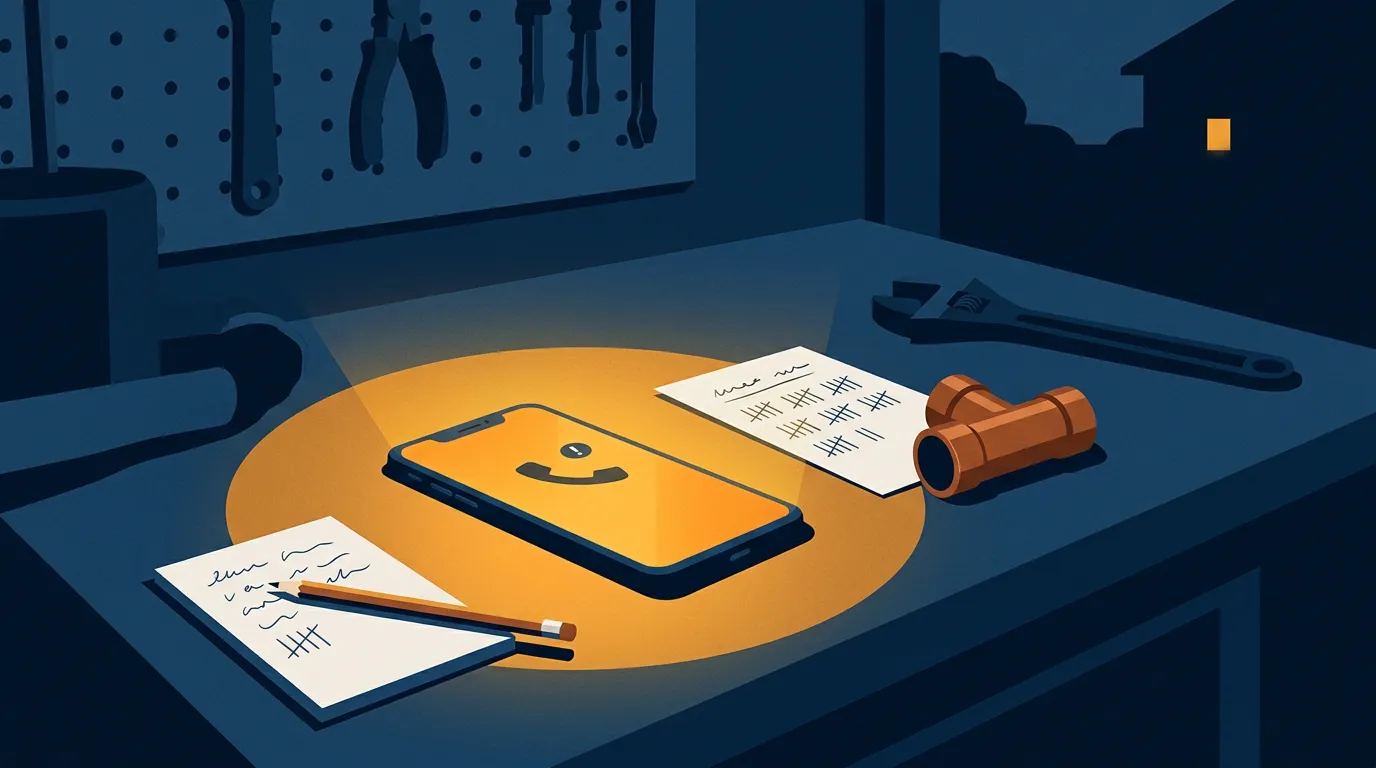
We've all done it. It's 7pm, you're elbow-deep in a water heater that was supposed to be a forty-five minute job, the phone buzzes in your pocket, and you make the call every tradesman makes: whoever that is, they can leave a voicemail.
They didn't leave a voicemail.
Nobody leaves a voicemail. The best number on this comes from Invoca's 2026 Home Services Benchmarks Report — 70M+ tracked calls. Worth saying plainly: Invoca sells call-tracking to the same market we do, and their sample skews toward bigger, multi-location shops, not one-truck outfits. No independent study exists to check it against. That's the honest caveat, and here's the number anyway, because it's the best one there is: 48% of home-services calls go unanswered industry-wide. Even the conservative cut of that — counting only calls that last past 30 seconds, filtering out misdials and instant hangups — still lands at 27% unanswered. Call it a solid 1 in 4, and most of those callers don't try again: they dial the next plumber on the list. That water heater you finished? Nice work. It may have quietly cost you a $900 job.
I'm going to walk through the actual numbers — how many calls a small shop misses in a week, what an average missed call is worth by trade, and what the fixes cost, from "hire a service" to "let software answer." Fair warning: I sell one of the fixes. I'll show you the math for the ones I don't sell, too.
The weekly math
Say a one-truck plumbing outfit takes 60 calls a week. At a 27% miss rate — the conservative Invoca cut, not the raw 48% — that's about 16 calls that ring out, hit voicemail, or get bounced to a machine. Not all of those are jobs — some are wrong numbers, some are people just checking a price. Call it half are real leads: 8-ish real missed opportunities a week.
Close rate on an inbound call for an established local plumber runs somewhere in the 30-40% range if someone actually picks up and books it. So of those 8 missed calls, maybe 3 would've become jobs. That close rate also assumes someone actually reaches the caller back on the first try — miss that part and you're not looking at a missed call anymore, you're looking at phone tag turning into a part-time job.
Average plumbing job value varies a lot by what kind of work you do — drain cleaning is cheap, a water heater replacement or a slab leak is not — but $300-$600 is a reasonable blended number for a residential shop. Call it $450.
3 jobs a week × $450 = roughly $1,350 a week, or about $5,800 a month, in jobs that rang your phone and then called somebody else.
That number moves around a lot by shop — this is deliberately rough math, and your real numbers might be a third of this or three times it. It's also rounder than it looks: rounding 2.8 jobs up to 3 above is what makes this $5,800 instead of $5,456, and we wrote up that $390 gap and the exact step that causes it. Our missed-call ROI calculator lets you plug in your own call volume, close rate, and job value instead of trusting my averages — then share or save the result. The shape of this math holds across trades, but the actual dollar figures move a lot by vertical — a missed new-patient call at a dental practice, for instance, runs a very different number than a missed plumbing call.
What the fixes cost
Do nothing. Free, and you keep losing whatever the math above says you're losing. This is what most one-truck shops are doing today, not because it's a good option but because nobody made the number visible.
Hire a full-time person to answer phones. Real cost is salary plus payroll tax plus the fact that one person can't cover nights, weekends, sick days, or the toilet break during your busiest hour. For a shop this size, this is usually the wrong tool — you're not big enough to keep someone busy 40 hours a week just answering calls.
A human answering service. Companies like AnswerForce or Smith.ai meter you — often per minute or per call, with overage fees once you're past your plan. This works, but the pricing punishes you exactly when you need it most — the week of a cold snap or a string of burst pipes is the week your bill spikes too. It's the same shape whether the surge is a cold snap for a plumber or the two weeks that decide an HVAC shop's whole season — metered pricing bills hardest exactly when the calls are worth the most.
An AI receptionist. This is the category we're in, and I'm obviously not neutral here, so take the pitch with the grain of salt it deserves. The honest version: instead of ringing to voicemail, it picks up, asks what's wrong and where, quotes your flat rate the same way every time with no upsell, and knows enough to tell a caller who mentions gas to get out and call the gas company instead of trying to be a hero. It doesn't book anything yet. There's no calendar, no confirmed time, and nothing about the call reaches you afterward, so turning it into an actual booking is still on you. It also isn't a human, and if that's a dealbreaker for your customers, it's not the right fix — but for most emergency home-service calls, "someone picked up and asked the right questions" beats "nobody picked up" every time, regardless of who or what answered.
The part where I tell you to check for yourself
I'm not going to ask you to trust the math above or my description of what Dialkeep does. The demo line is coming — when it's live you'll be able to describe a burst pipe and see what happens. If it fumbles, you've lost ninety seconds. If it doesn't, you've got real information instead of a blog post's word for it.
That's the whole pitch, really: don't believe us, dial.
Built for plumbers
Burst pipe at 2am doesn't care that you're asleep. Neither does this. It answers, asks what's happening and where, and gets the details while they're still on the line — instead of a beep they hang up on before dialing the next plumber.
Catch the 2am burst-pipe call (it picks up so you don't have to) →