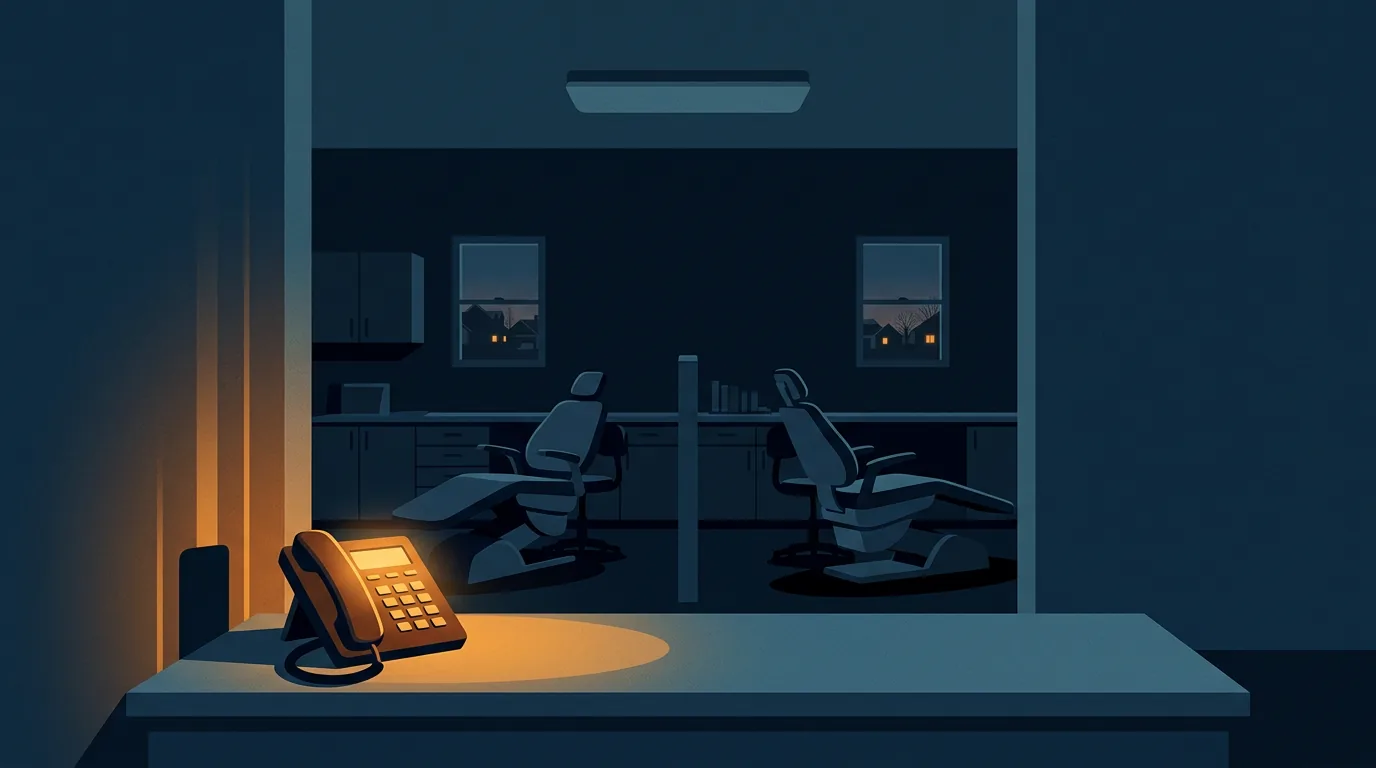
It's 12:40 on a Tuesday. Two patients are checking out, the hygienist needs a chart pulled for the 1pm, and your one remaining front-desk person (the other is at lunch) has a phone ringing she can't get to for another ninety seconds. She's not being careless. She's one person doing two jobs during the two hours a day your practice can least afford to be short-staffed.
That call rings out, or goes to voicemail. Either way, on the other end of it is very likely someone who has never been a patient of yours before, calling on their lunch break about a kid's first cleaning or a back tooth they've been ignoring for months. They are not going to sit on hold while you catch your breath.
I want to walk through what that call is actually worth, and what "a missed new-patient call" costs a small DMV practice once you run real numbers instead of a vague sense that it's probably fine. I sell one of the fixes for this, so weigh the back half accordingly. The math up front holds regardless of what you buy afterward, if anything.
Why a new-patient call is worth more than it sounds
Every call your front desk handles is not the same call. A returning patient confirming a Thursday cleaning can leave a voicemail and it costs you almost nothing: you'll call back in twenty minutes, she'll pick up, done. That's not the call I'm talking about.
A brand-new patient is a different animal. If you land them, they aren't worth one visit. They're worth the exam, the X-rays, the cleaning, whatever treatment follows, and then years of recall visits after that. The number I'd use, because it traces back to real DMV-market data on dental patient value rather than a guess, is $500 to $3,000-plus per new patient over the life of the relationship. A cleaning-only patient sits at the low end. Anyone who needs real treatment, like a crown or ortho or an implant, pushes well past $3,000 fast.
That range is wide on purpose. I'm not going to pretend I know what your average new patient is worth; only you know your case mix. What I want you to sit with is the shape of the number. Even the cheap end, multiplied by more than one missed call a week, adds up to real money fast, and the expensive end turns one bad Tuesday into a bad quarter.
The two windows where this actually happens
Trades lose calls to emergencies: a burst pipe at 2am, somebody who needs a plumber NOW. Dental loses calls differently, and I think it's worth being specific about how, instead of borrowing the trades' story wholesale.
The lunch-rush hole, noon to two. Your team eats in shifts or doesn't eat at all, because somebody has to stay on the desk while patients check in and out all day. That's also, not coincidentally, when a parent with a free half hour or someone on their own lunch break finally makes the call they'd been meaning to make. Your busiest hour and their only free hour are the same hour.
The after-5pm hole. Your office closes. The person calling at 5:20 with a toothache they've been putting off, or the parent who only remembers to make appointments once the kids are in bed, gets your voicemail greeting and a decision to make: leave a message and wait, or call the practice down the road that's still picking up.
Neither of these is an emergency in the ambulance sense, and that's exactly why it's easy to under-rate them, the same way a daily two-hour gap is easy to write off as unfixable until you actually put a number on it. Nobody's bleeding, so it doesn't feel urgent on your end. It's plenty urgent on theirs. A new patient shopping around is shopping right now, in the twenty minutes they've carved out of their day, and they will not wait for your callback when the next practice on their list answers on the second ring.
Either window gets riskier when the call itself carries a wrinkle a straightforward reschedule never does — a parent asking, in that same rushed breath, whether you take Smiles For Children or DC Medicaid, where guessing the answer loses the patient either way.
Run your own numbers
Here's where I want you to stop trusting my math and start using yours, because I don't know your call volume and I'm not going to invent a number and dress it up as an industry stat.
Take a rough guess at how many new-patient calls (not recall, not billing, just genuinely new patients) your practice gets in a typical week. Estimate what share of those land during the lunch window or after you've locked up. A reasonable guess is somewhere between a quarter and half, since that's when people who aren't already mid-appointment have time to call. Of that group, some fraction rings out to voicemail or gets a rushed, half-finished answer from someone mid-checkout. Multiply whatever number you land on by your own new-patient value, picking a figure in that $500-3,000+ range that matches what you actually see walk through your door, and you have a real weekly number, not mine.
For most 1-3 chair DMV practices, even a conservative version of that math (one or two genuinely lost new patients a week, at the low end of the value range) lands in the hundreds of dollars weekly, and adds up over a quarter to a number that would get a manager's attention if it ever showed up on a report. It never does, because a call that never happened doesn't leave a line item. The missed-call calculator I built for exactly this will do the arithmetic once you plug in your own volume and value; treat what it spits out as a model to sanity-check your instincts, not a verdict.
Why the DMV market makes this specifically expensive
Here's the part that's genuinely regional, and I'd tell any practice owner in NoVA, Montgomery County, or DC proper the same thing: you are not competing in a sleepy market. Dental advertising in this corridor is crowded and expensive. Practices are running Google Ads, Yelp placements, and referral programs to generate exactly the kind of new-patient call that then goes to voicemail at 12:45. If you paid to generate that call and then lost it to a ninety-second gap in coverage, you didn't just lose a patient. You lost the marketing spend that produced the call, and you're going to pay for another lead to replace them, in a market where a competitive keyword or a Yelp lead already costs real money before anyone even calls.
That's the piece I'd want a fellow practice owner to actually sit with. In a less competitive market, a missed call might get replaced cheaply by the next organic walk-in. Around here, replacing that lead usually means spending marketing dollars again to generate a call you already paid for once.
What I'd actually do about it
Do nothing. Free, and it's the default for most solo and small practices, not because it's a good choice but because nobody's put a real number on it before. The cost is everything above, quietly, forever.
Rearrange staff coverage. If you've got two-plus front-desk people, staggering lunches instead of taking them together closes some of the gap for free. It doesn't touch the after-5pm hole, and a true one-person front desk doesn't have this option at all.
A bundled platform like Weave. These genuinely solve phone coverage as part of a much bigger suite: hardware, reminders, review requests, patient communication tools. Their pricing page publishes one number and it's a floor: "simple plans and pricing, starting from $199 per month" (checked August 19, 2026 — the three named plans behind it, Pro, Elite and Ultimate, each sit behind a "Get Pricing" button, so what you'd actually pay is a quote, not a published figure). That floor is the same as the flat-rate option below, so this isn't actually a price question. It's a scope-of-purchase one: at that price you're buying a full patient-communication platform to get the phone answered, not just the phone-answering piece on its own. If all you actually need closed is the lunch-rush and after-hours gap, that's a lot of platform to take on to get there.
A flat-rate AI answering service. This is the one I'm building, so read the rest knowing that. The pitch is $199 a month flat, no hardware bundle, no per-minute meter. It's built to answer the noon-to-two call and the 5:20 call the same way it would answer at 9am: pick up live, ask the new patient's name and callback number and what they're calling about, and quote your configured exam fee exactly as you set it rather than improvising a number to a stranger. If someone asks an insurance or clinical question, the design is to refuse rather than guess — say it isn't the one who can answer that, and ask for the question in the caller's own words — because a wrong insurance answer is worse than no answer at all.
And here's where that stops, stated before you get any further into my pitch. It doesn't book. It doesn't put a caller through to a person — there's no transfer to your front desk, warm or otherwise. And it doesn't carry what the caller said back to your team afterward, by any route at all; the call ends and that's the end of it. It isn't HIPAA-anything either: there's no BAA on offer, so I'm not going to call the design "HIPAA-aware" and let that phrase do work it hasn't earned. What's true is narrower — the script asks for a name, a number, and a reason, and it doesn't discuss diagnoses or treatment specifics on the phone. So the thing this actually changes is the 12:40 caller's experience of your practice, not your front desk's afternoon.
Here's my inventory, honestly: a design built to handle the lunch-rush call the way I just described, and nothing live yet to prove it on — no working demo number for you to dial right now and hear it happen. What you can do today is look at what the practice page promises and decide if it's worth waiting for. When the demo line goes up, that's the actual test: you'll describe a kid's first cleaning during a simulated lunch rush and hear for yourself exactly how it handles her — the questions it asks, the fee it quotes, and the moment it refuses to guess.
The number that actually matters
Whatever you land on, the fix doesn't have to be the one I sell. It has to close the actual gap in your actual week, lunch rush or after 5pm or both, before the next practice down the road closes it for you. Run your own volume against your own new-patient value, not my hypothetical Tuesday, and buy the fix that matches how your phone actually rings. For the wider version of this math, every kind of missed call a small business takes and not just the new-patient ones, here's the full breakdown.
Built for dental / ortho practices
Your front desk is already slammed with patients in the chair — the new-patient call during lunch hour goes to voicemail, and voicemail loses to whoever answers first. This answers instead and gets the new-patient details down on the call, without touching anything clinical.
Stop losing new patients to the lunch rush →