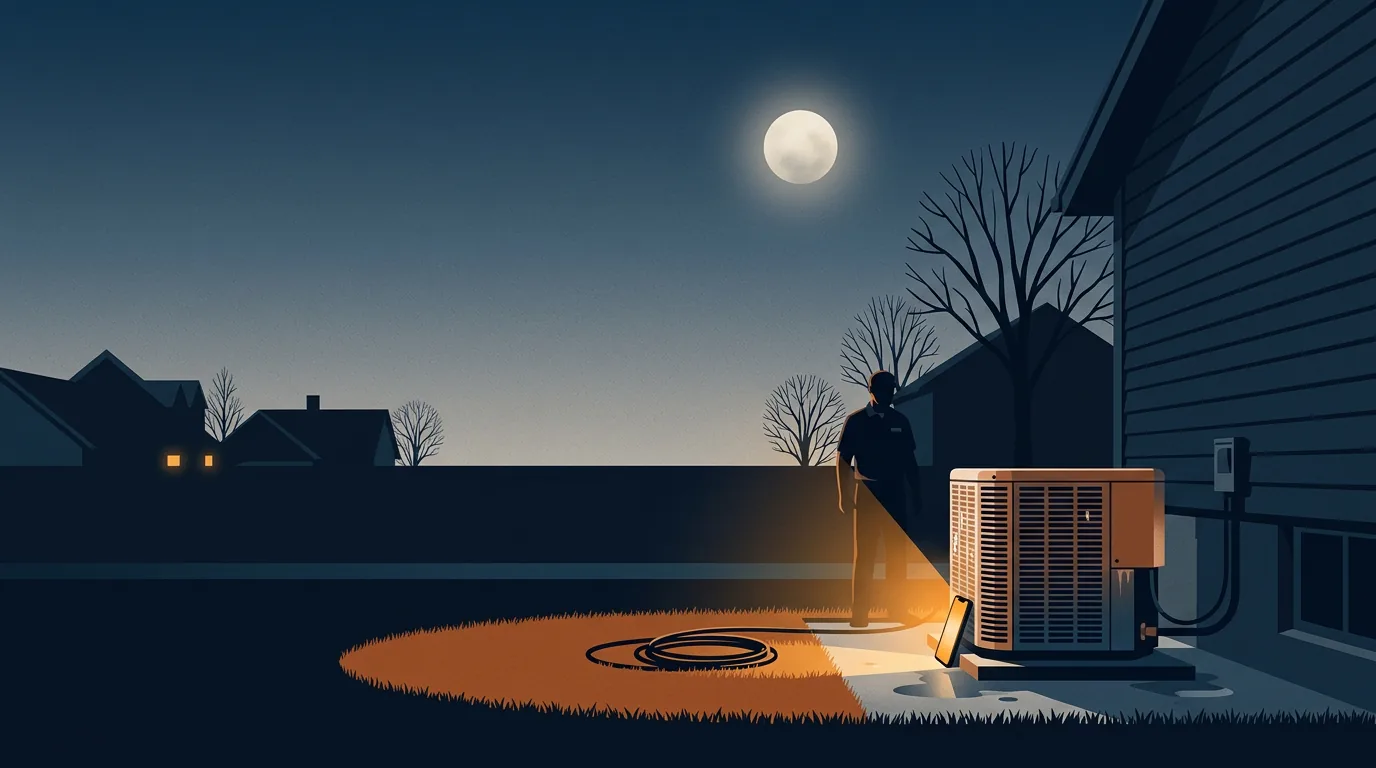
Two tickets, same imaginary shop, seven weeks apart
Picture two tickets, seven weeks apart, to make the point concrete — not a real job, just the shape of one.
Ticket one, early June, a rowhouse: "AC's running, just doesn't feel as cold as it used to." The tech finds a run capacitor limping along under its rating, swaps it for a part that costs less than the service call itself, and the system's back to spec inside twenty minutes. Routine repair. Everybody's happy.
Ticket two, late August, a split-level a few streets over: "AC's not doing anything at all." The tech shows up and the outdoor unit is dead — no hum, no click, no start attempt, nothing. Similar age unit to the June call, similar neighborhood, similar builder. This one isn't getting fixed with a capacitor and a screwdriver. The compressor's seized, or the contactor's pitted shut, or the windings have cooked themselves open. It's a same-day-or-you're-sleeping-in-97-degrees call, and it's probably a full-system quote, not a repair ticket.
Both callers said basically the same four words: "my AC's not working." Completely different job underneath. That gap — what a June call actually is versus what an August call actually is — is the thing DMV shops undersell, because whoever answers the August call needs to hear "no air at all" and know instantly that it isn't June wearing a tan.
What changes isn't the heat. It's the runtime.
Every DMV AC unit that's still running by late August has been running, more or less continuously, since the first real warm stretch — call it Memorial Day weekend most years. NWS normals for Reagan National put the average July high at 89.6°F and the average low at 72.4°F; August isn't far behind at 87.8/71.0. Notice what's missing from those numbers: a real overnight break. A low in the low-to-mid 70s means the compressor isn't shutting off for eight hours and resting — it's cycling all night too, just less aggressively than at 4pm. Across ten to twelve weeks of that, a system logs run-hours a June tune-up call never accounts for.
A capacitor, a contactor, a start relay — none of these components care that it's "only July." They care about cumulative cycles and cumulative heat exposure sitting in a condenser cabinet baking in direct sun. A part that was weak but functional in June, quietly degrading with every start-stop cycle since, doesn't get stronger by August. It gets closer to the cycle where it finally doesn't make contact, and that cycle is statistically much more likely to land in week ten of continuous duty than week one.
The humidity tax a drier climate doesn't pay
There's a second factor stacking on top of raw runtime, specific to this region rather than "it's humid here" hand-waving. An air conditioner does two separate jobs: remove sensible heat (temperature) and remove latent heat (moisture) — the second job is the expensive one. Building-science researcher Allison Bailes of Energy Vanguard explains that in humid climates a system typically handles only 50 to 70 percent of the actual dehumidification load on its own — the rest is why a house still feels sticky at the thermostat's setpoint. Dry climates mostly skip this problem: there isn't much moisture in desert air to wring out.
The DMV isn't a desert. Mid-Atlantic summer air carries real moisture, which means a compressor here isn't just fighting temperature — it's running longer cycles to wring out humidity the thermostat doesn't even measure. That's runtime a drier-climate system of the same tonnage simply doesn't accumulate over the same ten weeks. It's a genuinely regional mechanical fact, not a generic "summer is hot everywhere" line, and it's a real part of why the DMV's late-season failure cluster looks different from what a shop in Phoenix or Albuquerque sees on the same calendar date.
Why the same-sounding call means something different in August
Put those two things together — accumulated runtime plus a humidity-driven duty cycle that never really rests — and the character of the calls themselves shifts under a shop's feet without anyone deciding it should. Early-season calls tend to be comfort complaints: running a little warm, cycling oddly, a noise that's been there a week. Late-season calls tend to be absence complaints: no air moving at all, the outdoor unit not attempting to start, a breaker that trips the second it tries.
That's not a semantic difference. "Not quite cold enough" can wait for a normal-priority slot. "No air at all" on a 95-degree afternoon, especially with a baby, an elderly resident, or anyone with a health condition in the house, is a different urgency tier — the kind of call the missed-call math piece frames in dollars, though the more immediate cost here is safety. A shop still triaging every "AC not working" call the way it did in June will under-prioritize real August emergencies, in the exact stretch of the year that affords that mistake least. The two weeks that decide your HVAC season covers the surge-volume side of a heat wave; this is the companion problem underneath it — the calls aren't just more frequent late in the summer, they're a different kind of call, and a restart after a utility cycling event is one specific trigger for exactly this late-season failure pattern.
What that means for whoever's actually answering your phone
If you, your spouse, or a tech between jobs is fielding calls, the fix is mostly a mindset shift: by late July, stop treating "AC issue" as one bucket. Ask the follow-up that separates the buckets — is there any air moving at all, warm or cool, or is the outdoor unit doing nothing — before you decide how fast that caller needs a truck. It's the same question either way, but the answer means something different than it did in June, and the caller on the other end of an August "no air at all" call is often not in a position to wait for your normal callback window.
Where Dialkeep fits, honestly
This is the category we're building in, so take the rest of this with that in mind. Dialkeep isn't live yet — the demo line is coming — but the design target is a triage script that knows the difference between "running a little warm" and "no air at all," asks the follow-up question that separates them, treats a household with a baby, an elderly resident, or someone with a health condition as the higher urgency tier it is rather than one more "AC issue," and gets the address and symptom down accurately on the call regardless of who's holding the phone that afternoon. It's priced flat — $199 a month, unlimited calls, no per-minute meter that runs hottest the exact week your call volume does — details on the HVAC page. To be straight about the limits, and not just the convenient ones: it doesn't diagnose a seized compressor or quote a repair over the phone. It doesn't schedule the visit. And nothing the caller tells it reaches you — not the address, not the symptom, not a recap, not a log of who called. Not automatically, and not by some slower manual route in the background either; there's no bridge yet between what's said on that call and what you know about it afterward. Everything on your side is exactly as manual as it's always been. What it's built to change is just the ninety seconds when the phone rings: a caller with no air at all gets triaged correctly instead of treated like a June comfort call, whoever's closest to the phone.
Match the triage to the actual week
If your shop already has a sharp ear for this — if whoever answers instinctively asks "any air at all?" before booking a slot — this is validation, not news. If nobody's formalized it, late July is the moment to write the follow-up question down and use it consistently, because the calls arriving over the next several weeks are less likely to be June's calls in disguise. Same four words on the intake sheet. Different job waiting at the end of the driveway.
Built for hvac contractors
The AC dies on the hottest day of the year and the customer starts working down the list. This answers, gets the symptom, the address, and how urgent it is down on the call — and the price is the same in a heat wave as it is in October.
The first heat wave doesn't have to cost you jobs →