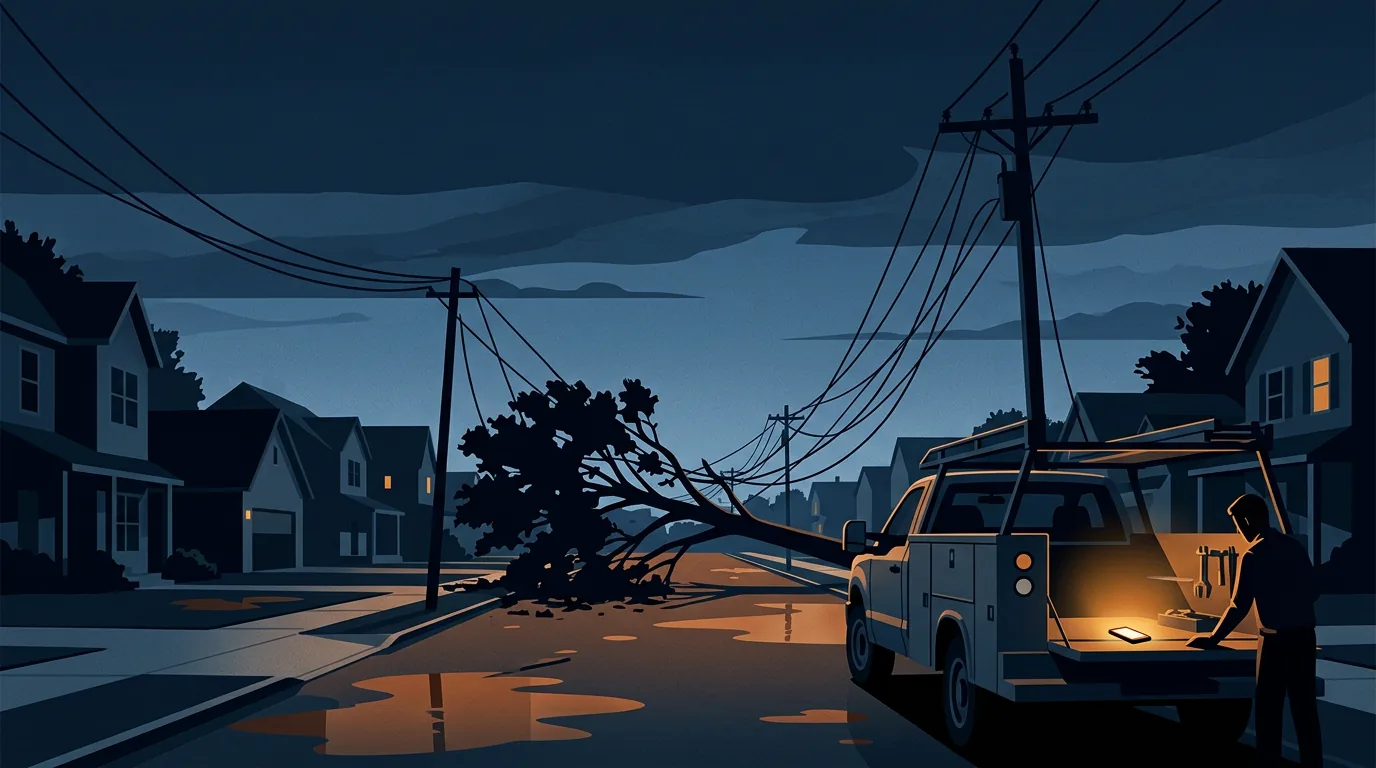
It's the Tuesday after a derecho rolls through, and your phone has not stopped ringing since Sunday night. Not "busier than usual." Ringing the way it rings maybe twice a summer, every call sounding like it matters, half of them sounding like they can't wait, and you are one truck trying to be in six places at once while your own voicemail box fills up before noon.
I want to walk through why that week is different from every other busy week you have, why the DMV specifically produces it, and what I'd do to plan for it before the storm watch goes up instead of during the fifth hour of it. I sell one of the fixes for the phone part of this problem, so weigh that section accordingly. The planning part holds regardless of what you buy.
The pattern, not just "storms happen"
Every trade in this region deals with weather, and I don't want to lump electrical in with the rest of them, because I think what makes electrical work different after a major outage event is the shape of the call surge, not just its existence. A plumber's freeze week spreads pipe failures out over days as houses individually give up. An electrician's outage week arrives almost all at once, because the trigger is a single event — high winds and falling trees taking down lines and knocking out power across whole neighborhoods in the same hour.
The DMV's real history backs this up, and it's worth knowing even if you've only lived here a few years. The most infamous case is the June 2012 derecho, a fast-moving line of severe thunderstorms that knocked out power to much of the region for days, in the middle of a heat wave, with almost no warning before it hit. That kind of event isn't a once-a-decade freak accident here — this region sits in a corridor where a severe summer storm system, sometimes reaching derecho intensity, is a real seasonal risk through the peak of summer into August. You don't need the exact statistics to plan around it. You need to accept that some August, probably this one or the next, a storm like that is coming back, and your phone is going to do the same thing it did last time.
What actually floods the phone
I think it's worth being specific about what these calls actually are, because "storm calls" undersells how different they are from a normal service week.
Downed-service calls. A tree limb takes the weatherhead off the side of a house, or a line comes down across a driveway, and now there's a genuine safety question sitting in someone's yard — is it live, is it the utility's wire or the customer's, can anyone go near it. These are the ones I'd want triaged first: they come in fast and scared, and a chunk of them are genuinely urgent in a way a flickering switch never is.
Generator-hookup panic calls. Power's been out six, twelve, twenty-four hours, someone just bought a generator at the hardware store that's still selling out, and they want it wired in tonight, safely, before they either burn the thing out or backfeed the grid and hurt a lineworker. Picture how many of these you'd field on the second night of an outage — nobody's in danger yet, but a bad DIY hookup is how people get hurt, so you can't just let them sit in voicemail either.
Surge-damage diagnostics. Power comes back on, and now it's the calls that start a day or two after the storm: a dead AC unit, appliances that won't turn on, a panel that smells faintly of something burnt. Your caller was never watching the lights flicker off and on eleven times before the line finally died, but that's often exactly what happened, and it's hard on electronics — which means these keep trickling in for days after the outage-week rush you thought was over.
Three genuinely different jobs, arriving in the same 48-to-72-hour window, from customers who are each convinced theirs is the emergency. That's the part that makes an outage week different from a routine busy week: it's not more of the same call, spread over a normal pace. It's three call types you don't usually see stacked at once, compressed into two or three days, most of them sounding urgent because for the caller, they are.
Why this is genuinely different from a routine busy week
I want to be specific about why, because "busier than usual" undersells it. A routine busy week is manageable because it's spread out — you can triage calmly, most callers can wait a day, and your voicemail greeting buys you real time. An outage week breaks all three of those assumptions at once. Everything lands in the same 48 hours instead of spreading across a normal week. A much larger share of it is safety-adjacent instead of routine. And your own capacity to answer calmly is lower, not higher, because you're also out running the actual jobs the storm created. The math I'd use on a normal Tuesday — let it go to voicemail, call back between jobs — falls apart exactly when the volume and the stakes both spike together.
Planning coverage ahead of the next storm watch
Here's what I'd actually do, in the order I'd do it, before the next storm watch goes up rather than during it.
Decide your triage rules on a calm day. Write down, while you're not under pressure, what counts as "drop everything" versus "book for tomorrow": a downed line near people or pets is drop-everything; a generator-hookup question from someone who already has power restored elsewhere in the house can wait a few hours; surge-damage diagnostics almost always can wait a day. Deciding this in advance means whoever answers the phone during the surge — you, a family member, an employee, or a receptionist tool — is applying a rule instead of guessing under pressure.
Pre-arrange help for the surge window specifically. If you've got a buddy system with another local electrician for slow nights, ask now whether that same arrangement can flex to cover a storm week, when both of you are likely slammed but maybe not on the exact same hours.
Know what your current answering setup does to your bill on a surge week. If you're on a per-minute or per-call metered service, this is worth checking now: a metered plan can jump hard exactly on the week your call volume jumps, because a storm surge is the one week the meter and your workload agree with each other, and not in your favor. AnswerForce, one of the bigger names in this space, runs on a per-minute or quote-based structure (they don't publish their rates) — priced in a way that punishes exactly the outage-night surge you didn't create and can't control.
Consider what a flat-rate line does to that math. This is where I'll tell you plainly that I sell one of the options here, so weigh it accordingly. Dialkeep is built to run at a flat $199 a month, unlimited calls, specifically so a storm knocking out power to half the neighborhood doesn't cost more than a quiet Tuesday. What it's built to do on a surge night is the unglamorous half: pick up instead of ringing out, take down who's calling and what's happening, and cost the same doing it at 1am on the worst night of the year as it does on a quiet Tuesday. It does not transfer anyone to a human, it does not write to any calendar or scheduling tool, and it does not decide which of those calls is the dangerous one — I'd want an electrician profile built and tested before I claimed any of that, and there isn't one. Here's where I owe you the catch, and it's a real one: none of this has answered a live storm-night call yet, because Dialkeep isn't switched on. The demo line is still being built, so I can't point you at a number and say describe a downed weatherhead at 1am and watch it decide — not today. When that line does go up, that outage-night scenario is exactly the test I'd want you to throw at it before you trust it with a real surge. Until then, the electricians page lays out what it's being built to do, and you can decide whether it's worth waiting on.
If a flat-rate AI receptionist isn't the fix you want, the after-hours options I'd weigh for any DMV trade — letting it ring, forwarding your own cell, a buddy rotation, a metered human answering service — are laid out in more detail in the after-hours coverage guide for this region, including the tradeoffs of each one against a call volume that spikes with the weather.
Plan it now, not mid-event
The August derecho pattern isn't a guess about the future, in my view — it's this region's documented seasonal risk, and pretending otherwise means you're doing your triage planning live, under pressure, with a scared caller on the line and five more waiting. I'd decide the escalation rules, line up the backup coverage, and know exactly what your current phone setup will do to your bill and your calm before the next storm watch goes up, not after your voicemail box is already full.
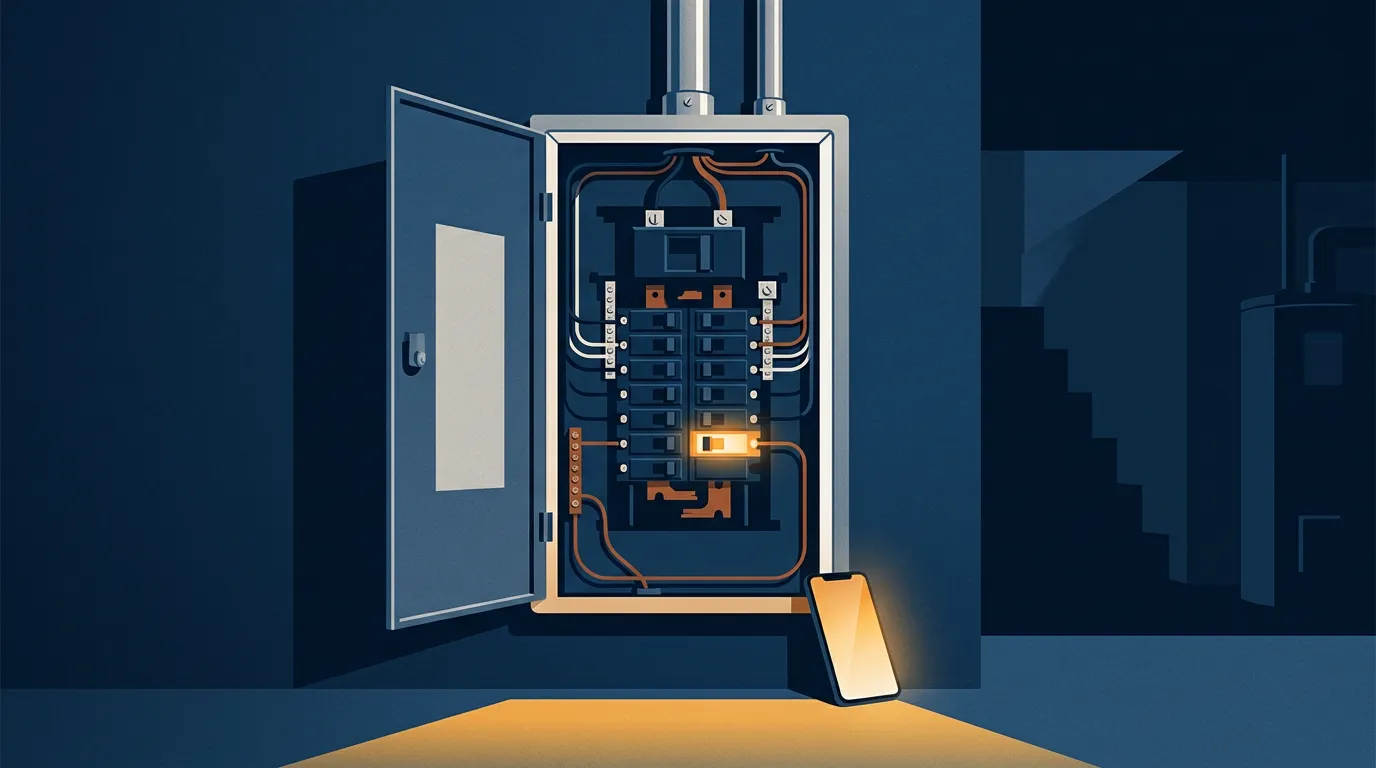
Built for electricians
A flickering switch can wait till Tuesday. A sparking panel can't wait five minutes, and voicemail can't tell the difference. Neither does this — not yet. No electrician profile exists today, and it does not walk a caller through safety steps on any line. What's real right now: it answers and captures the details on every call.
Catch the sparking-panel call while you're still on the ladder — it picks up so you don't have to →