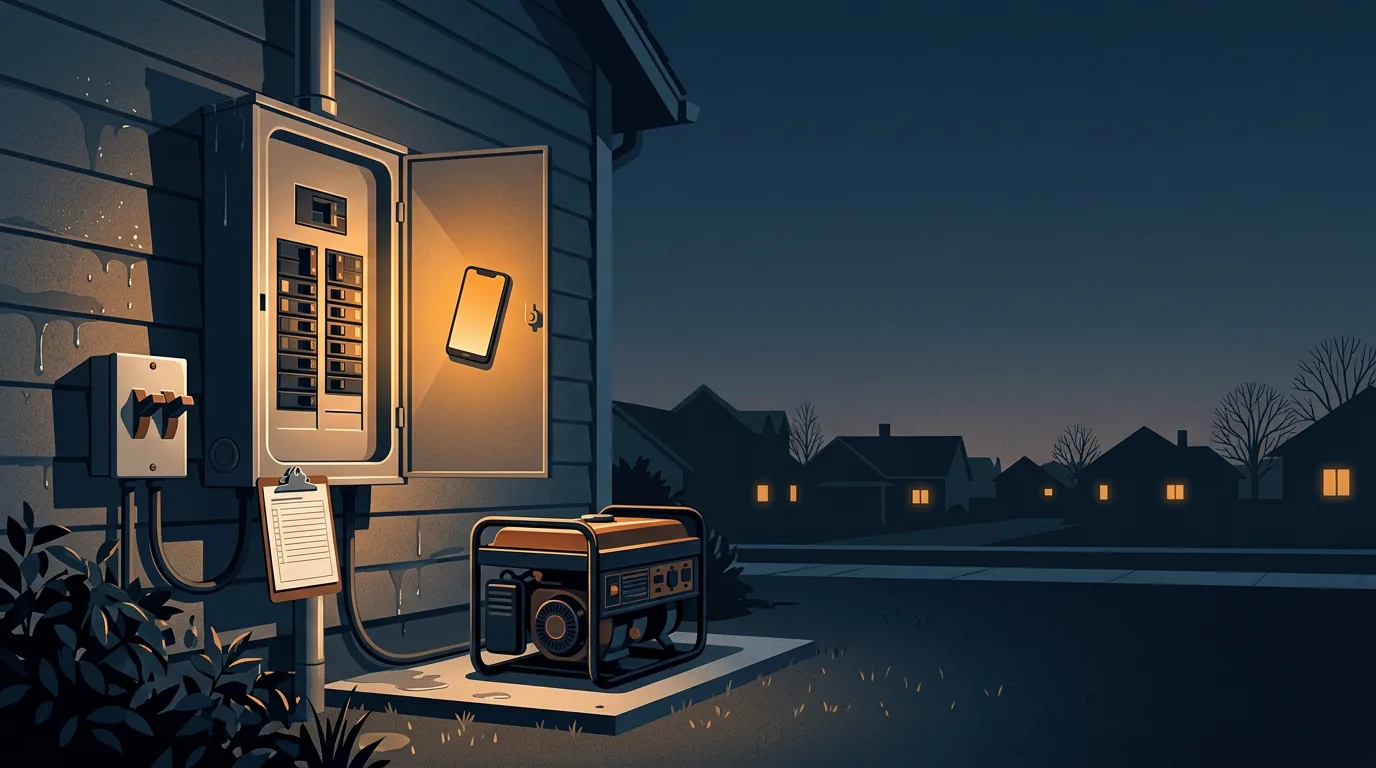
The panel's already open, the interlock plate's on the workbench, and the homeowner asks the question every one of these calls gets to eventually: "So when does someone come look at it?" They installed the generator — or had you install it — because the power went out for two days last time and the freezer thawed. Now there's a metal plate holding the main and generator breakers apart so both can never be on at once, and somewhere between "it works" and "it's done," an inspector has to sign off.
Here's what catches DMV electricians off guard if they haven't fielded one of these in each jurisdiction: DC, Maryland, and Virginia aren't running the same electrical code right now, let alone the same inspection checklist. Tell a Bethesda customer what a DC inspector wants to see and you'll be half wrong. Here's what's actually different, jurisdiction by jurisdiction, so you can set the right expectation on the first call. It's the same county-line problem you run into quoting an EV charger install across DMV counties — the correct answer depends entirely on which side of a line the panel sits on.
One disclaimer up front: I'm not a code official, this isn't legal advice, and none of it substitutes for calling the actual agency on a specific job. Code editions and local amendments change — verify before you promise a customer anything in writing.
Why "which code year" isn't a footnote
Every DMV jurisdiction has adopted the National Electrical Code — but not the same edition, and for a generator interlock that matters more than for most residential work, since transfer-equipment requirements are an area the NEC keeps tightening edition over edition.
DC is currently running the 2014 NEC. The 2017 DC Construction Code — effective May 29, 2020, and still DC's current code as of this writing — incorporates the 2014 National Electrical Code, not 2017 or 2020, per DC's own construction-codes page.
Maryland and Virginia have both moved to the 2020 NEC. Maryland's electrical code is based on NFPA 70, 2020. Virginia's current Uniform Statewide Building Code — the 2021 edition, mandatory statewide since January 18, 2024, grace period ending January 17, 2025 — also references the 2020 NEC.
If you're used to interlock work in Fairfax or Montgomery County and then take a DC job, don't assume the inspector is applying the same edition's language to transfer equipment. Call DC's Department of Buildings and confirm which article and edition applies before promising a customer a pass.
DC: licensing is the gate, not just the inspection
DC's electrical permit covers "repair, replacement, or installation of an electrical system" — broad enough to plainly include an interlock or transfer switch install. What trips up out-of-district crews is who's allowed to pull that permit: DC doesn't issue owner-permits for electrical work the way some Maryland counties allow on limited homeowner projects. It has to be pulled under a licensed DC Master Electrician, full stop. If a homeowner mentions a cousin already touched the panel, flag it — the inspector is checking that the permit on file matches who did the work, not just the interlock plate.
Maryland: Montgomery and Prince George's County, two different specifics
Montgomery County treats a residential standby generator as licensed-electrician-only work from the permit stage forward. The county's own generator permit process states plainly that homeowners can't apply for a residential generator permit themselves — it has to go through a Maryland State Board of Master Electricians-licensed electrician, with a marked site plan submitted through the county's ePlans system before the permit issues.
Prince George's County has a specific physical-separation requirement worth knowing before finalizing a transfer-switch layout: per the county's electrical permitting guidance, the emergency system and the transfer equipment must be separated by a wall with a minimum two-hour fire rating, under County Code Subtitle 9, §9-109.01. That's not a generic NEC clearance rule — it's PG County–specific, and it's exactly what fails an inspection when a layout gets planned around a basement that was never checked against it.
Virginia: the county runs it, and plan review kicks in at higher amperage
Virginia routes generator and interlock permits through the county (or city) building department, not a state agency or the utility. Fairfax County is a useful regional benchmark: per Fairfax County's residential electrical permit requirements, any service at 600 amps or greater requires submitted plans — a service riser diagram with conduit and conductor sizing, overcurrent protection, and grounding detail; at 800 amps or greater, plans need to be signed and sealed by a Virginia-registered design professional. Most single-family interlock jobs won't near either threshold, but a job bundling a panel upgrade with the generator work should check this first.
Loudoun County runs a comparable process, and generator work there commonly touches both the electrical permit (panel, wiring, interlock) and a separate building or zoning sign-off for the physical unit placement, pad, and gas line — a second permit that's easy to forget when you're focused on the panel. Across Northern Virginia, inspections check against the current USBC's 2020 NEC baseline plus local amendments, so a Virginia customer's expectations shouldn't be set using a DC or Maryland conversation as the template.
Setting the expectation on the first call
None of this changes what the interlock plate does — the same physical safety function everywhere, keeping the utility and generator sources from ever being connected at once. What changes is who's allowed to pull the permit and what gets checked, entirely a function of which side of a county or district line the panel sits on. Getting the address right on the first call is the difference between telling a DC customer the correct licensing requirement and a Fairfax customer the correct plan-review threshold, instead of confidently quoting the wrong jurisdiction's rule.
That's a bigger version of a problem every electrician knows: whoever answers the phone has to get the basics right — the address, spelled back, not guessed at — before anything else matters. If that call goes to voicemail instead, you're decoding a rushed, garbled address off a recording at 9pm, hoping you heard the county right. Dialkeep is built to answer the call and capture the address correctly, so the jurisdiction question starts from a real address instead of a scrambled one. Dialkeep isn't live yet — the demo line is coming, and when it's live you'll be able to test that yourself. It won't tell a caller which inspection rules apply; that's still yours to get right.
For the broader math on what a missed call costs a shop your size, see how many calls a small operation actually misses, and for more on triage on the calls that do come in, see triage as the actual job.
The bottom line
DC's still on the 2014 NEC and requires a licensed Master Electrician to pull any electrical permit. Maryland's on the 2020 NEC, with Montgomery County locking generator permits to licensed electricians from the application stage and Prince George's County enforcing a two-hour fire-rated separation between the emergency system and transfer equipment. Virginia permits through the county building department under the 2020 NEC-based USBC, with plan-review thresholds at 600 and 800 amps. Same interlock plate, three different inspection realities — the only way to get it right on the first call is knowing which one you're standing in.
Built for electricians
A flickering switch can wait till Tuesday. A sparking panel can't wait five minutes, and voicemail can't tell the difference. Neither does this — not yet. No electrician profile exists today, and it does not walk a caller through safety steps on any line. What's real right now: it answers and captures the details on every call.
Catch the sparking-panel call while you're still on the ladder — it picks up so you don't have to →