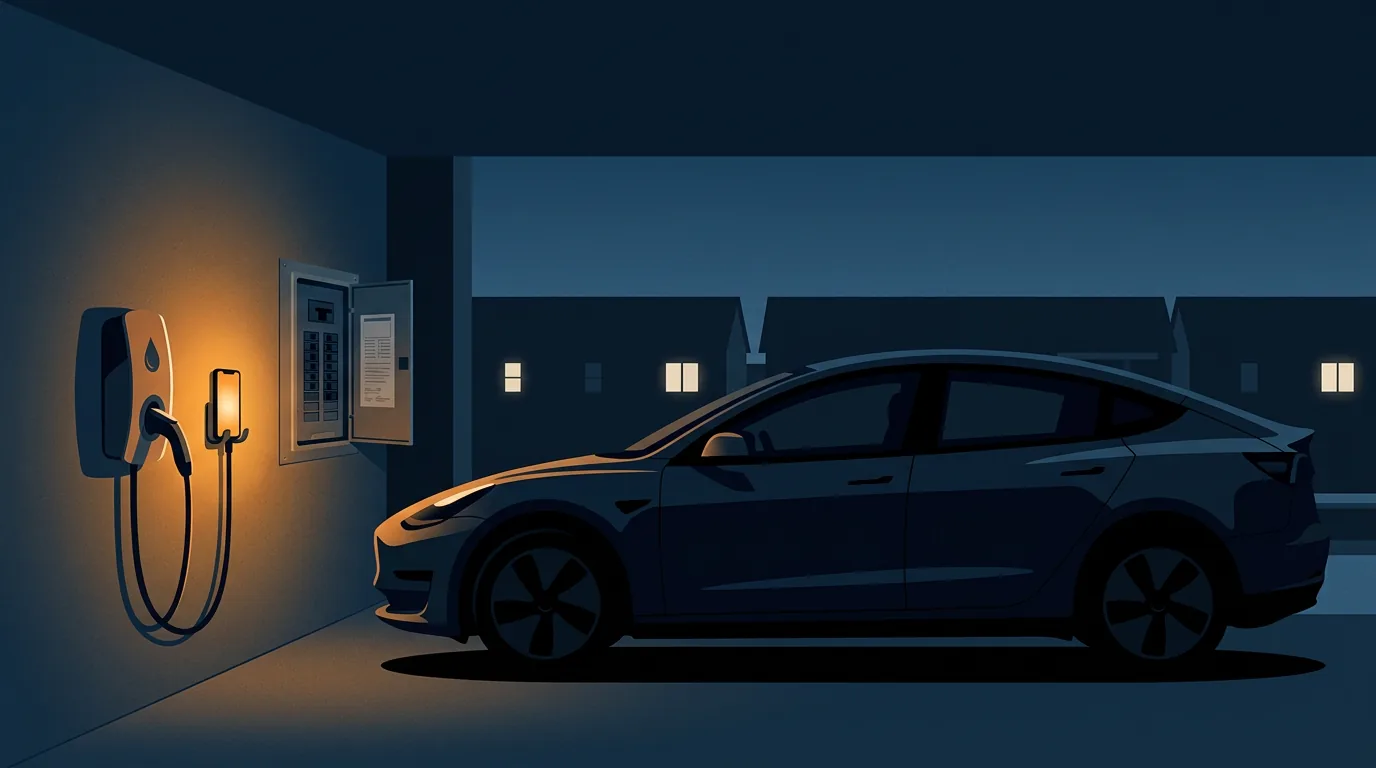
Somebody calls wanting a Level 2 charger installed in their garage. You ask a couple of friendly questions, throw out a ballpark number so you don't lose the job to the guy who calls back faster, and hang up feeling fine about it. Then you show up and find a 100-amp panel from 1987 with zero open slots, a hundred-foot run from the panel to where the car actually parks, and — surprise — it's a townhouse on a shared electrical service with two other units. Your ballpark number is now a fantasy, and you get to have the "actually, it's going to cost more" conversation in person, which is a worse conversation than the one you could've had on the phone.
That callback loop is avoidable. It's avoidable because the variables that actually drive an EV charger quote are knowable in a two-minute phone call, if you ask the right five or six questions before you say a number out loud.
The DMV's EV boom is happening behind garage doors you can't see from the street
Loudoun, Fairfax, and Montgomery County are consistently named among the highest-EV-adoption suburbs on the East Coast, and the demand shows up in the same shape every time: someone bought (or leased) an EV, drove it home, and is now standing in their garage realizing the included charging cable is slow and the wall outlet isn't built for daily fast charging. That's a Level 2 install call. It's good, steady work — refreshingly, not the kind of call that needs the sparking-panel-vs-flickering-switch triage a real emergency does. It is also work where the phone conversation determines whether the estimate means anything or whether it's a number you'll have to walk back.
The reason it's tricky to quote blind is that "install a charger" isn't one job. It's five or six different jobs wearing the same request, and which one you're actually being asked to do depends entirely on what's already at the house — the panel, the run, and in a lot of NoVA and Prince George's County developments, the building itself.
Why "just want a charger" isn't enough information
A charger install price moves on a handful of physical facts, not on how badly the customer wants it done Saturday. Two houses with the identical charger request can be a $600 job and a $3,000 job, and the only way to tell which one you're walking into is to ask before you quote, not after you arrive.
Here's the checklist. Read it on the next EV-charger call, and don't give a number until you've got answers to most of it.
The intake checklist — ask this before you quote:
- Panel amperage. 100-amp, 150-amp, or 200-amp service? A charger that's easy to add on a 200-amp panel with room to spare can require a full panel upgrade on a tired 100-amp panel that's already carrying HVAC, an electric range, and a dryer.
- Panel age and make. Roughly how old is the panel, and do they know the brand? Older panels sometimes have known reliability issues worth flagging before you commit to working inside one — this alone can change the scope from "add a breaker" to "replace the panel first."
- Open breaker slots. Does the panel have physical space for a new double-pole breaker, or is it full? A full panel with no room means a subpanel or a tandem-breaker conversation before the charger conversation even starts.
- Existing electrical load. What else is running off that panel — HVAC, electric water heater, range, other big draws? This is the difference between "plenty of headroom" and "we need a load calculation before anything gets installed."
- Distance from the panel to the parking spot or garage. Ten feet of conduit and eighty feet of conduit are not the same invoice. Ask where the car actually parks, not just where the garage is, since some setups charge in a driveway or a carport well past the garage wall.
- Service type. Overhead or underground service, and — this is the one that trips people up in townhouse-dense parts of the DMV — is this a single-family home with its own dedicated panel, or a townhouse on a shared electrical service?
That last one deserves its own line, because it's a NoVA and Prince George's County specialty. A lot of townhouse developments in that corridor were built with shared electrical infrastructure between units, or with panels in shared utility spaces rather than inside each individual home. If the caller doesn't know which kind of setup they have, "townhouse" alone is your cue to ask more before you guess a price — a shared-service job can mean coordinating with a condo or HOA board, not just wiring a garage.
- Charger type and amperage requested. Hardwired unit or one that plugs into a NEMA 14-50 outlet? 32-amp, 40-amp, 48-amp? The customer may not know this yet, which is fine — but it's worth asking what vehicle they're charging, since that points you toward what they'll actually need.
- Mounting location. Interior garage wall, exterior wall, or a detached structure? Outdoor mounting brings weatherproofing requirements that indoor mounting doesn't.
Answer those seven or eight questions on the intake call, and you're quoting a real job instead of a guess. Miss them, and you're doing this same conversation twice — once on the phone, once standing in the driveway.
On permits: don't guess, confirm with the AHJ
A Level 2 EV charger install is generally a permitted electrical job, and it's the kind of work that typically also gets inspected once it's done — that much is safe to say across the board. What's not safe to say is anything more specific than that. Permit requirements, fees, and the exact review process vary by jurisdiction, and the DMV region alone spans several distinct ones. The honest, correct answer on the phone is: confirm the permit and inspection requirements with the local authority having jurisdiction (AHJ) for that specific address before you finalize scope. Don't quote a permit fee or timeline from memory, and don't let a customer assume "no permit needed" just because a neighbor's job didn't need one — that's a fast way to get a stop-work order mid-install. The same jurisdiction-by-jurisdiction reality shows up on generator interlock jobs too — DC, Maryland, and Virginia inspect those differently as well, right down to which code year each one's actually running.
The part where I mention what we're building
If you've read this far, you already know why this matters: the quote is only as good as the intake. That's phone tag in miniature — every one of these questions that doesn't get asked on the first call becomes a second call, a site visit that doesn't need to happen, or a customer who got a real number from someone else first. It's the reason we're building Dialkeep to run this same EV-charger intake list on every call — panel amperage, panel age, distance, service type, the townhouse-shared-service question — so the estimate that lands on your desk is built on real numbers instead of a guess made on the fly between jobs. Dialkeep isn't live yet, and this specific intake list is the design target, not a built brain today — the demo line is coming. (Flat $199/month, no per-minute metering, if that's useful context once it's live.)
Use the list, save the trip
You don't need a system to do this. You need the eight questions above, asked in order, every time an EV-charger call comes in — on a sticky note by the phone if that's what it takes. The panel, the distance, the service type, and the townhouse question will tell you almost everything you need to know before you ever see the garage. For the rest of what a missed or rushed phone call costs a small electricians shop, the math holds up the same way it does for every other call type: the information you get in the first two minutes is worth more than the quote you give in the first thirty seconds.
Built for electricians
A flickering switch can wait till Tuesday. A sparking panel can't wait five minutes, and voicemail can't tell the difference. Neither does this — not yet. No electrician profile exists today, and it does not walk a caller through safety steps on any line. What's real right now: it answers and captures the details on every call.
Catch the sparking-panel call while you're still on the ladder — it picks up so you don't have to →